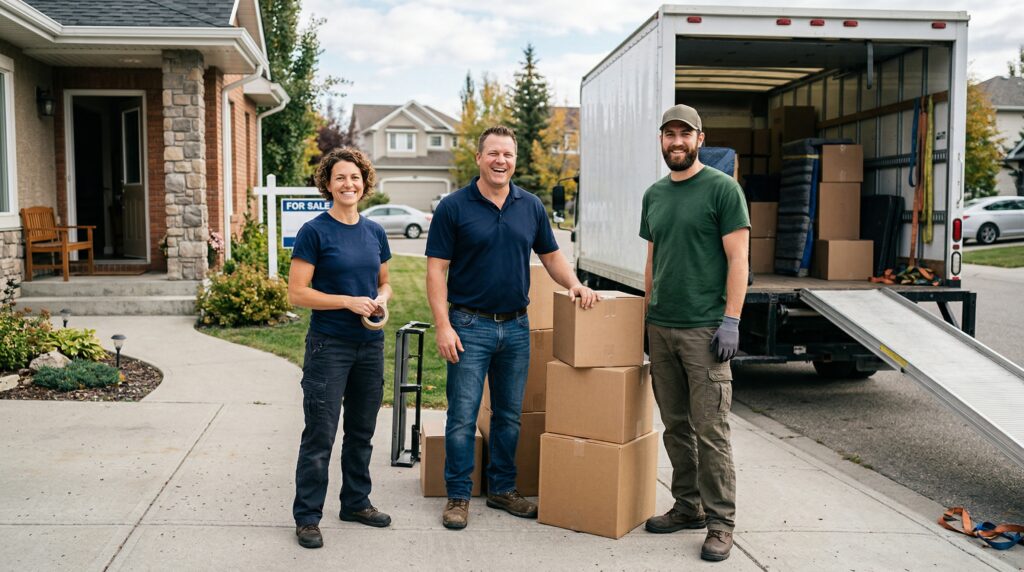
A move from Calgary to Vancouver is rarely the kind of story where you pack a few boxes at night, load everything in the morning, and trust the rest to somehow fall into place. Long-distance moving works differently. It is not only about the truck itself, but also about the sequence, the packing logic, the unloading flow, and even which items should stay close during your first hours after arrival. In real life, a move almost always looks a little less polished than it does in glossy marketing images: one last mug is still drying after being washed, a box of cables is sitting in the hallway waiting for its “later” moment, and someone suddenly remembers the seasonal clothes on the top shelf of the closet. That is normal.
At Magic Move, we look at routes like this in a calm and practical way. A Calgary to Vancouver move is not just a trip from one point to another, but a full process that becomes much easier when it is built step by step. That is why we do not like chaos for the sake of action. We prefer a clear working rhythm: first understand the volume, then sort through the details, then prepare the belongings for the road, and only after that move into the transportation stage. When everything follows the right order, even a big relocation feels different – more structured, quieter, and easier to understand.
Why a Calgary to Vancouver move needs a different kind of planning
A move from Calgary to Vancouver needs a different approach simply because this is not a short city relocation where some decisions can be made on the fly. On a longer route, improvisation quickly stops being convenient. If the loading order, the box contents, and the basic first-day essentials are not thought through in advance, the fatigue starts building faster than most people expect. Then comes the moment when someone is looking for a kettle, a charger, or a change of clothes somewhere between decor boxes and bookshelves worth of packed items (very common, no need to panic).
When we talk about planning this type of route, we are not talking about making things overly complicated. It is more about practical thinking brought into a clear structure. How much is really going with you. Which furniture pieces should stay assembled and which ones make more sense to take apart ahead of time. Which items should be loaded last so they are easier to access after unloading. Are there fragile things that should never be mixed in with standard boxes. Are there belongings that need extra care during transport. On a long-distance move, those details stop being small details very quickly.
This route also requires more solid planning because people often experience it more emotionally. They are not only changing an address, but also a daily rhythm, a home environment, sometimes a job, and sometimes a whole routine. Against that background, boxes and furniture may seem secondary, yet they often become the most frustrating part if the move is poorly organized. The sound of plastic wrap, the dull thud of stacked boxes, a hallway that no longer lets you turn around properly, the early morning before departure – all of that feels sharper when there is a long road ahead.
That is why we always start from one simple idea: a good move does not begin when the items are lifted into the truck. It starts much earlier. With a conversation about the details. With practical questions. What really matters to you in this move? What should be unloaded first? Which belongings need more attention? Do you need help with furniture disassembly? The clearer the moving scenario is from the beginning, the easier the whole chain works afterward. And that difference is noticeable right away. Not on paper, but in the real pace of the day, when the move does not fall apart into scattered, stressful pieces.
What people often underestimate before moving from Calgary to Vancouver
Before a long-distance move, many people do not underestimate the amount of work itself, but the speed at which small tasks begin multiplying. It feels like there are not that many boxes. It feels like the furniture can be prepared in one evening. It feels like documents, chargers, medication, and first-day essentials will somehow stay visible and available. Then, at the least convenient moment, “just a few extra bags” become an entire corner of the hallway, and the things you actually need are not where you thought they would be.
This is not about people being disorganized. It is simply how moving usually works. Belongings build up quietly over time. Some items stay unpacked because they are still being used. Fragile objects remain separate because they need more protection. And then there is the category of “we will deal with this later”, which somehow absorbs everything from lamps to cables, from dishes to the storage shelf contents. On a long route, underestimating these details almost always makes the process harder.
People also tend to underestimate the unloading stage in the new place. It often seems like the hard part is reaching Vancouver, and everything after that will feel easier. In reality, the final stage can be just as important as the start. How should the boxes be placed so they do not need to be moved around the room three more times? What should go straight to the kitchen, and what belongs in the bedroom first? What should be opened that same evening, when energy is already low and the room still smells like cardboard, stretch wrap, and fresh outdoor air coming in through the door? If none of that is considered in advance, arrival can easily become another exhausting stage.
Another common thing people underestimate is the effect of rhythm. When a move feels too fragmented, full of stops, last-minute searches, and hurried decisions, exhaustion grows much faster. And when the sequence is clear, even a large volume of belongings feels more manageable. That is why we always suggest looking at a move not as one giant stressful day, but as a chain of concrete steps. It works better physically and mentally.
How to make a long-distance move feel more organized and less overwhelming
To keep a long-distance move from feeling like one endless rush, it helps to divide it into clear parts. Not into ten pages of instructions, of course, but into practical stages. What gets prepared in advance. What should be packed separately. What needs to stay easy to reach after arrival. Which items need extra protection. Which belongings truly matter during the first twenty-four hours, and which ones can wait. When those categories are not all mixed together, the move becomes much easier to manage.
That is really what good organization means – not pretending the job is small, but removing unnecessary chaos. You do not need to turn your home into a flawless warehouse with labels on every inch of space. Sometimes it is enough that the main groups of belongings are sorted clearly, fragile items are separated, and furniture is prepared in a way that avoids dealing with it during the most stressful moment. We often see how even a little clarity at the beginning saves a surprising amount of energy at the end.
From our side, structure begins with practice. We look at how the loading should be arranged, what is worth disassembling, how the items should be distributed inside the move, and what should remain accessible. These are not dramatic trade secrets. It is more like steady working discipline, the kind that quietly shapes good service. How the boxes are placed. How the furniture corners are protected. Whether one section is overloaded while another is too loose. These details do not always stand out in conversation, but they stand out very clearly in the result.
There is another important point: a long-distance move feels less exhausting when the client does not have to keep guessing what happens next. A clear process always works better than an impressive but vague one. When it is obvious which stage we are in, what has already been prepared, what comes next, and which decisions are better made early, the tension drops. There is no magic in that. Well-organized work simply feels calmer. Even if the day starts early, the air is cool, and the coffee has to be finished on the go.
Moving services that can be adapted to the way you are relocating
One of the most common myths about moving is that the same service format works for everyone. In reality, the opposite is true. Some people are moving from a compact apartment where the priority is to handle the main furniture, boxes, and a few fragile items carefully. Others are relocating from a full house, where the volume is completely different, the furniture count is higher, there are more household details, and there is more preparation involved. Then there are clients with more specific needs: disassembling larger furniture, helping with careful wrapping, or making sure the unloading sequence in the new place feels practical from the start.
That is exactly why we do not look at the Calgary to Vancouver route as one identical checklist for every client. We prefer an approach where the services reflect the real situation. Only need transportation? Then the main focus becomes the loading flow and route planning. Need help preparing furniture? We build that in. Have belongings that need more careful handling? Then that becomes part of the process from the beginning. That kind of setup is usually more honest and more useful than trying to force the same package onto every move.
In real life, a move is rarely made up of abstract categories. It is made up of concrete household tasks. A bed that makes more sense to disassemble ahead of time. A table that needs more careful protection because its surface scratches easily. Dishes that seem minor until they take up far more space than expected. A box with documents and electronics that should stay easy to find. A few suitcases that no one wants to dig out from the middle of dozens of sealed boxes after arrival. This is what a service is really built around when it is meant to help, not just look complete on paper.
We believe the client should understand why each stage matters and why each option is being suggested. Not for the sake of a “full package”, but for the sake of a smoother move. When services are chosen around the actual needs, the route feels more practical. Fewer unnecessary movements. Fewer situations where something has to be redone in the last minute. Less of that feeling that the move is running on its own without your control. And more steady, organized work built around a clear goal – moving everything carefully without overcomplicating the experience for the person involved.
What helps the final stage of a Vancouver move feel easier after arrival
The final stage of a move is often treated like something secondary: the main thing is getting there, and the rest can be sorted out later. In reality, arrival has a huge effect on the overall impression of the move. If unloading feels chaotic, if the boxes end up in the wrong places, if the things you need most disappear somewhere inside the larger volume, the exhaustion hits harder. Especially in the evening, when the light gets softer, movements slow down, and the new home still echoes with that hollow room sound and the quiet crackle of packing wrap underfoot.
That is why a good move does not end on the road. It continues in the way the final stage is handled. What comes in first. Which items go directly into the right room. What should be assembled early so the space starts feeling livable sooner. Sometimes all it takes is having the bed, the basic furniture, and the first important boxes placed logically, and the entire home already feels less unfamiliar. That is not a minor thing. That is the moment when the new address starts becoming real instead of just official.
We always approach arrival as something that should feel like the natural end of the route, not one last exhausting push. For that to happen, sequence matters. If the basic items are accessible, if the furniture has been prepared properly, and if unloading follows a clear logic, it becomes much easier for the client to deal with the rest without extra fatigue. And when the final stage is left to chance, a lot of the care invested in the earlier parts of the move loses some of its value very quickly.
A Calgary to Vancouver move can absolutely be long, tiring, and demanding by nature – that part is true. But it does not have to feel disorderly. At Magic Move, we help build the process in a way where each stage supports the next one. With clear preparation, careful loading, well-thought-out transportation, and a more structured unloading flow after arrival. When the route is organized that way, it does not feel like endless stress. It feels like a serious move, yes, but one that is still very manageable from start to finish.
 Skip to content