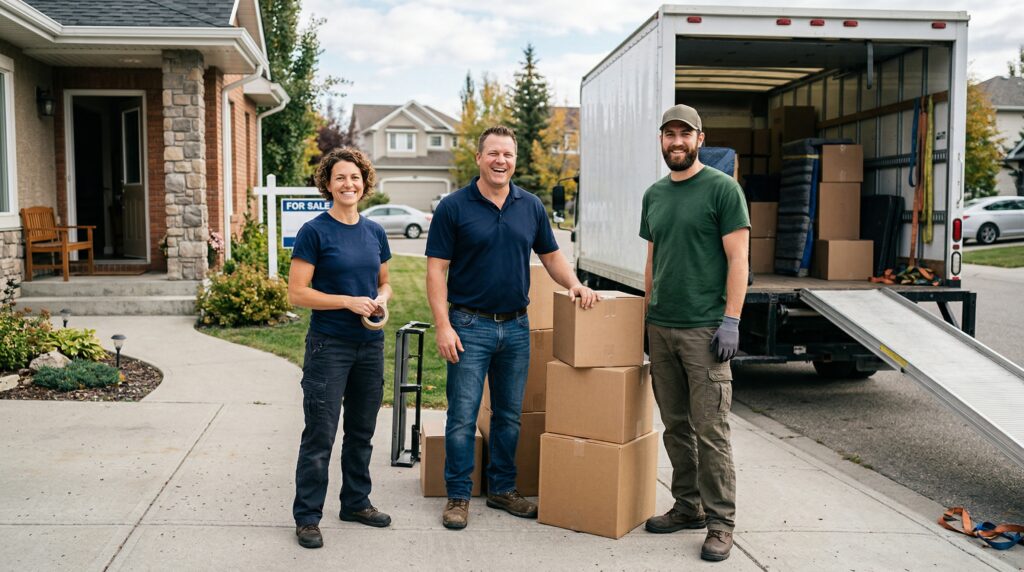
A move from Calgary to Saskatoon rarely looks especially difficult until the home starts turning into boxes. At first, it all seems manageable enough. There is furniture, there are electronics, there are belongings that feel like “just a few things.” Then suddenly there is another set of bedding, more dishes than expected, a box of cables no one has opened in months, and a very important drawer of “miscellaneous” that somehow weighs as much as a small planet. That is usually when the honest thought arrives: a long-distance move is not just a road between two cities. It is a process where details, order, and timing matter far more than people expect at the beginning.
At Magic Move, we look at routes like this calmly. No heroic slogans, no pretending that everything can be solved with one elegant gesture. A good move from Calgary to Saskatoon is not built on luck. It comes from practical work: understanding the real volume, building a sensible packing system, keeping the important items from disappearing into the general load, and making sure that once you arrive, you do not spend the next several days sorting out the consequences of rushing. On longer routes, it becomes especially clear where the move was organized properly and where everything was held together by the phrase “we’ll deal with it later.” And the second version is almost always more exhausting.
What to consider before moving from Calgary to Saskatoon
Until the actual moving day arrives, relocation often feels like something still in the future and not quite real yet. While everything is still in place and the kitchen still looks like a kitchen, it feels as though there is plenty of time and everything is under control. But long-distance routes do not respond especially well to last-minute decisions. That is why preparation begins not when the truck arrives, but with a much simpler question – what exactly is waiting for you in this move? How many belongings are there? What is large? What is fragile? What will you still be using until the final day? Where is inconvenience most likely to show up first? Calm usually begins with those questions.
We always suggest seeing the move as a whole, not in disconnected pieces. Not just the drive to Saskatoon, but also the morning of departure, the first evening after unloading, and the small everyday details that suddenly become very important. Because moving is not one long push. It is a sequence of decisions, and the clearer that sequence is, the easier the rest becomes.
The first thing worth assessing honestly is the real volume. Not by mood and not by guesswork. Usually people think there are “not that many things” until they reach the storage area, the hallway шкаф, the upper kitchen shelves, and all the places where useful and not-so-useful items have been gathering for years. Then suddenly it becomes clear that there are far more boxes than expected, and the move requires not optimism, but actual structure.
The second important part is understanding what must remain accessible until the very end. Some items can be packed early and ignored until Saskatoon. Others should stay close: documents, medication, chargers, basic clothes, hygiene items, a mug, a kettle, something for the first evening and morning. Those things should not be blended into the rest of the load. Otherwise the new place greets you not with relief, but with an expedition through identical boxes.
It also helps to think ahead about furniture. What can realistically be moved without trouble, and what is better prepared in advance? Are there pieces that make more sense to disassemble? Are there surfaces that scratch easily or catch on corners? In a long-distance move, details like these matter more because the road itself is already adding strain to the process, and it is better not to create weak points before the trip even starts.
And of course, timing. We are not talking about waking up at five in the morning and becoming the hero of the day. We are talking about giving the move rhythm. Once part of the preparation is already done, the morning no longer turns into a race involving tape, markers, and anxious coffee. That alone changes the whole feel of the route.
Packing, furniture, and documents – where confusion usually begins
The most frustrating confusion in a move is rarely dramatic. It usually arrives very quietly. The documents are “somewhere separate.” The charger “should be here.” The kitchen box somehow ended up in another corner of the room. And furniture that looked completely ordinary yesterday suddenly begins behaving like a complicated machine with opinions. None of this feels like a crisis at first, but these are exactly the details that make the day heavier and longer. That is why it helps not to rely on memory and improvisation.
We often see that confusion appears not because of the route to Saskatoon itself, but because there is no simple system. Once there is no clear logic for what goes where, everything starts blending together. Then suddenly the most important things are hidden deepest, and the most inconvenient boxes are labeled with the mysterious word “miscellaneous.” For some reason, that “miscellaneous” box almost always becomes the main character of the evening.
Packing is straightforward. It either helps, or it takes revenge later. Dishes tossed into random cartons, books in giant boxes, clothing mixed with cables, documents tucked between decorative odds and ends – all of that returns eventually. There is nothing magical about it. Just the consequences of rushed choices.
That is why we prefer a clear system. Fragile items separate and protected properly. Heavy things packed without turning one box into an unnecessary strength test. Documents, medication, and essentials separated from the general volume. And yes, a box labeled “miscellaneous” rarely improves anyone’s life. It is much better to label what is actually inside, even if the wording sounds boring. Boring is fine. Convenient is better.
Furniture follows the same pattern. One of the most common mistakes is assuming that if something sits nicely in a room, it will move just as easily through a doorway, down a staircase, and across a long route. Not always. Some wardrobes are unexpectedly confident about their width, some dressers weigh far more than they appear to, and some tables develop complicated relationships with narrow turns. What helps here is not heroism or “we’ll just carry it through,” but preparation and a realistic view.
And then there are documents. They take up very little space, they make almost no noise, they never look especially impressive, and yet they are often the hardest thing to find at the wrong moment. So the rule here is simple: no random places, no “I’ll move them later.” Important things should live in one clear, separate place. On moving day, your brain already has enough to do.
How to make a long route feel clearer and more manageable
What makes a long-distance move feel intimidating is not only the number of kilometres. Very often it is the uncertainty. What happens first? What comes after that? At what point does the whole thing begin to feel like a real process instead of several different problems happening at once? The good news is that a long route can be made clearer. Not with a magic trick and not with one perfect checklist on the fridge, but with sequence. Once the day has structure, even a large amount of belongings stops feeling endless.
We always want the move to feel like a route with logic, not a collection of accidents. Morning, loading, road, arrival, unloading, the first few hours in the new place – these are all different stages. Once they are not mashed together into one anxious mass, the whole process feels much calmer. And on a long move, calm is not a luxury. It is practical.
A lot depends on order. First, the things that are ready. Then the larger items. Then the belongings still used until the last moment. Once this logic exists, there is less running around, fewer pointless pauses, and less of that feeling that the whole move has somehow stalled for no visible reason. Even the air in the room feels different when the process is not jumping from one task to another.
It also helps to think ahead about what happens after arrival in Saskatoon. What should go inside first? Which boxes should head directly to the correct rooms? What will be useful on the first evening without a long search? Once you think not only about leaving Calgary but also about the first hours in the new place, the whole route becomes much more human. That matters. People do not move just for a beautiful unloading scene. They move so they can live normally afterward.
There is another detail people often underestimate. The move becomes easier once you stop trying to solve absolutely everything yourself through constant control. Control does not always mean doing everything personally. Sometimes it means setting up the process properly so that each part of the work happens in the right place. That saves energy, and you will definitely want that energy after the road.
In the end, a clear route is not about a dry system. It is about the feeling that the day is not breaking apart. That the move has a beginning, a middle, and a calm, workable finish. And that changes a lot.
How to build the process around your home, your belongings, and your schedule in advance
One of the most useful things in moving is letting go of the idea that there is one universal perfect scenario for everyone. There is not. One family has children and needs certain things accessible until the final hour. Another client works from home and has electronics and paperwork that should never disappear into the general load. Some people have little furniture but many fragile details. Others have almost no décor, but several seriously heavy items. That is why a good move begins with a simple thought: the process should adapt to you, not the other way around.
That is exactly how we work. What matters to us is not only the list of belongings, but the daily life inside that list. What do you use every day? What can be packed early? What makes sense to remove first? What should stay closer to the exit? This is where real organization begins. The move stops feeling like a natural disaster and starts feeling like a practical task.
If your schedule is already tight, there is no point planning the move as if a free week and endless patience are waiting in the background. It is much better to divide the work into stages. What can be packed several days before departure? Which parts of the home should remain untouched for now? Which boxes should be ready in advance? The more realistic the plan, the smaller the chance that the final evening turns into simultaneous kitchen packing, document hunting, and confusion about why the tape has run out at exactly the wrong moment.
The home itself matters too. Where are the narrow passages? Which furniture is better disassembled? What is difficult to carry without advance thought? Are there items that can be damaged easily during the usual rush? When those things are considered early, loading goes more smoothly. There is no need to invent solutions in the doorway when everyone is already tense and eager to speed up.
It is also worth planning a first set of essentials for life after arrival. Not as a “we’ll deal with it there” idea, but as something deliberate. Because after a long drive to Saskatoon, most people want to find the basics and exhale, not solve puzzles in a box maze. Once this set is packed separately, the new home starts feeling like home much faster.
In the end, a process built in advance is simply a way of removing unnecessary noise from the move. The work is still there, but it feels clearer, gentler, and much less dependent on improvisation. That is already a strong result.
Calgary to Saskatoon with Magic Move – when moving is organized in a human way
What people need in a long-distance move is not just transportation. They need a process that does not fall apart on the road and does not turn the entire day into a sequence of rescue operations. They need a team that understands that boxes are not abstract cargo. They are someone’s kitchen, someone’s paperwork, someone’s electronics, children’s things, clothes for tomorrow, and a lot of everyday life. That is exactly the understanding we bring to our work at Magic Move. To us, a Calgary to Saskatoon route is not only about kilometres. It is about helping a person move through a major transition with less strain.
We do not build our work around noise. We prefer order. Belongings packed with logic. Loading that does not turn into a chaotic fight for space. Unloading that does not become a tired evening riddle. A well-organized move should not feel like a heroic performance. It should feel like a serious task handled properly. Honestly, that is how moving should work.
At Magic Move, we look at the route as a whole. From the first boxes in Calgary to the moment when you can already find what you need in Saskatoon without wanting to sit down on the floor among cartons and say absolutely nothing for a while. We think about the large and the small at the same time. Furniture, volume, loading order, protection for fragile items. And the mug you will want in the evening. The charger. The towel. The documents. The ordinary objects that become strangely important after a long drive.
What matters to us is that you do not live through the move as chaos under the slogan “at least we made it.” Yes, arriving matters. But how you get there matters too. How much unnecessary rush the day contains. How clear the process feels. How much energy remains by evening. That is why proper organization almost always beats beautiful improvisation.
A move is still a move. There will be boxes, rustling wrap, the sound of tape, footsteps in rooms that are slowly emptying, and that slightly strange feeling that the space is already adjusting to something new. That is normal. But once there is a real process around it, everything feels softer. Less panic. Less meaningless rushing. Less of that constant sense that the situation needs rescuing every half hour.
That is why at Magic Move we focus on one simple thing – a move that is comfortable in a human way. Not theatrical. Not built on promises. Real. Clear. Calm. The kind of move where the route from Calgary to Saskatoon stays in memory not as endless exhaustion, but as a serious step that was handled properly from beginning to end.
 Skip to content